
REVIEW · FRESH PASTA WORKSHOPS
Lecce: Pasta Making Class in 1400s-Era Courtyard with Wine
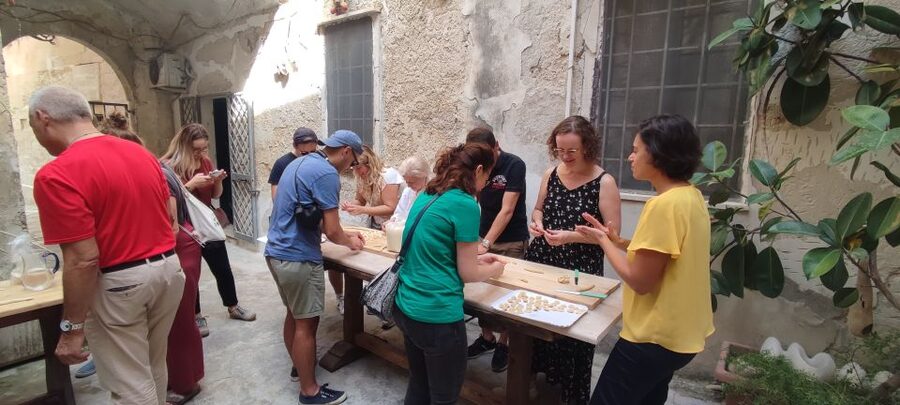
Lecce’s best pasta lesson takes place in an unlikely kitchen: the courtyard of the Faggiano Archaeological Museum, a setting dating to the 1400s. You’ll sit with local cooks, work flour and water into dough, shape orecchiette and Sagne, then eat what you made with wine.
I like two things right away: the class is genuinely hands-on, and the old courtyard gives the evening a strong sense of place. You are not just watching a demonstration. You are expected to pinch, roll, correct, and try again.
The main drawback is the group size. Classes can reach about 20 people, which adds laughter and a friendly international feel, but it can also make the work area feel crowded. Pasta shaping is trickier than it looks, so you may need to wait for help at busy moments.
Key Points
- A 1400s courtyard kitchen: The class takes place inside the Faggiano Archaeological Museum in central Lecce.
- Two Apulian pasta styles: You learn the hand movements behind orecchiette and Sagne, with some sessions also described as making maccheroni.
- Local instruction: Cooks including Teresa and other local pasta makers guide the class, with multilingual help from people such as Luciana.
- A meal at the end: Your freshly made pasta is cooked and served with wine, and some sessions include snacks, dessert, or local music.
- A social evening: You share tables and conversation with people from several countries.
- Good value at $68: The price covers the cook, equipment, class, museum setting, pasta meal, and wine.
Why This Pasta Class Works So Well in Lecce
Lecce is famous for pale Baroque stone, narrow lanes, and excellent food. Yet the most memorable way to understand Apulian cooking is often to work with your hands. This class connects a local dish to the people and place that produced it.
Orecchiette means little ears, a name that makes sense once you see the small cupped shapes. The dough is pushed, cut, and turned by hand. Each piece looks simple, but getting the thickness and shape right takes practice.
Sagne offers another look at the region’s pasta traditions. The class focuses on mixing water and flour, handling the dough, and using the basic tools of the trade. You do not need professional kitchen skills, but you should expect to make a few odd-looking pieces before your hands catch on.
I like that the lesson does not treat pasta as a museum object. You make it, cook it, and eat it. The meal at the end gives the class a clear purpose, and it is satisfying to taste the difference between something shaped by hand and dried pasta from a packet.
More Fresh Pasta Workshops in Italy:
- Rome: Pasta Making Class with Wine, Limoncello, and Dessert
★ 4.9 · 3,177 reviews - Pastamania – Florence Pasta Making Class
★ 5.0 · 3,050 reviews - Enjoy Spritz and Pasta Making in Piazza Navona
★ 5.0 · 1,681 reviews
Meeting the Cooks at the Faggiano Museum
Your meeting point is Via Ascanio Grandi 58, at the Faggiano Archaeological Museum. This is directly in the center of Lecce, so you can reach it on foot if you are staying in the old town. Transport is not included, and there is no need for a separate pickup if you arrive at the address yourself.
The museum setting is a major part of the experience. You are not entering a modern cooking studio with stainless-steel counters and bright commercial lighting. The courtyard has the character of an old Lecce home, and the age of the building gives the evening a more personal feel.
The cooking team has included local women such as Nonna Teresa, along with guides and language helpers such as Luciana and Therese. Names and staffing can vary, but the basic arrangement is consistent: one or more cooks demonstrate the pasta work while a guide helps explain the steps in Italian, English, or French.
I especially like this setup for visitors who want more than a recipe. The cooks bring the direct, practical style you would expect from someone who has made pasta many times. They may correct your technique, show the movement again, or tell you to keep working when your first attempt looks more like a strip than an ear.
The First 30 Minutes: Flour, Water, and Dough
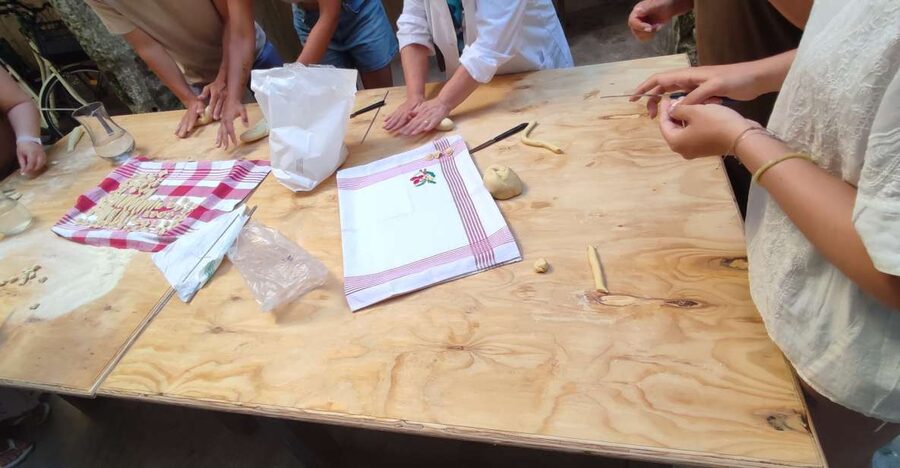
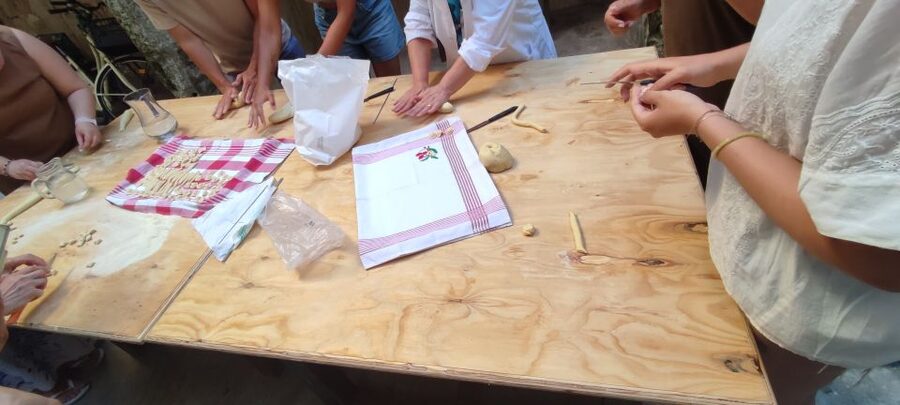
The class begins with the basic dough. You learn how to mix flour and water and how to bring the mixture together before shaping it. Cooking equipment is included, so you do not need to bring tools from home.
This part looks easy in a demonstration. It is less easy when the dough is in front of you. The amount of water, the pressure of your fingers, and the way you roll the dough all affect the final pasta. That is part of the fun, but it is also why the class can feel a little demanding.
The cooks and assistants provide guidance as you work. If you are struggling, ask for the movement to be shown again. The language support is useful here, since a gesture often explains the technique better than a long speech.
I would not choose this class if you want to sit back with a drink while someone else does all the work. You will be handling flour and dough for much of the lesson. For families, couples, and solo visitors who like practical activities, that active format is the point.
Shaping Orecchiette and Sagne by Hand
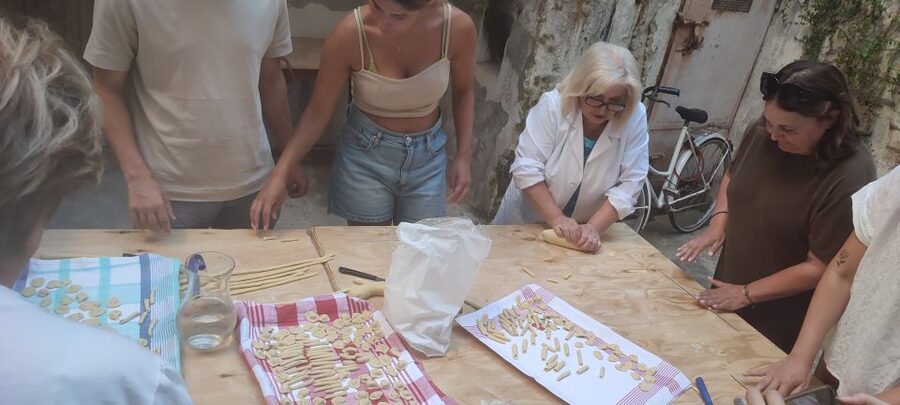
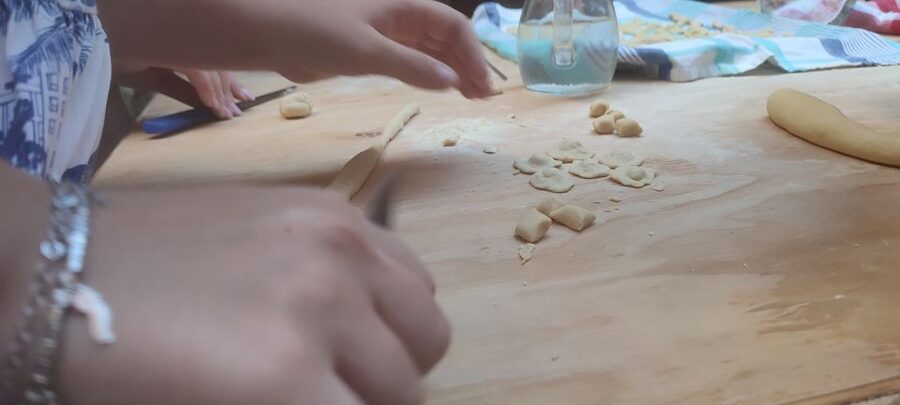
Once the dough is ready, you begin shaping the pasta. Orecchiette is the star, and the small ear-like pieces require a particular motion with a knife or other simple tool. You cut a piece, press and pull it, then turn it to form the hollow center.
The cooks make it look quick and natural. You may find that your first pieces are too thick, too flat, or not hollow enough. That is normal. Several people describe the technique as harder than expected, which is useful to know before you arrive.
Sagne gives you a second style to practice. The shapes are different, but the same basic lesson applies: pasta making rewards patience more than force. Keep the dough even, follow the demonstration, and let the local cooks correct your hands.
A helpful attitude is to treat the first batch as practice rather than a test. The class is meant to be social and relaxed, and the imperfect pieces still become dinner. You do not need to produce restaurant-quality pasta to enjoy the evening.
Some sessions have also included maccheroni in the practical work, and the exact combination of shapes may vary. The core focus remains traditional Apulian pasta, especially orecchiette and Sagne.
More Pasta Classes with Wine in Italy:
- Florence: Pasta Cooking Class with Unlimited Wine
★ 4.9 · 10,285 reviews - Florence: Pasta & Tiramisu Cooking Class with Unlimited Wine
★ 4.9 · 6,708 reviews - Florence: Pasta Cooking Class with Unlimited Wine
★ 5.0 · 6,413 reviews - Rome: Pasta & Tiramisu Class with Fine Wine by the Vatican
★ 4.9 · 4,852 reviews
Waiting for the Pasta to Cook
After the hands-on work, the pasta is prepared for the meal. This creates a natural pause. You can wash up, enjoy wine, and talk with the other people at your table while the pasta cooks.
The social part matters more than you might expect. The class often brings together people from several countries, and the shared work gives everyone an easy subject for conversation. You have already watched one another struggle with the same dough, so introductions come naturally.
Some evenings include snacks or an appetitivo before the meal. A few sessions have also featured dessert or local music while the pasta cooked. These additions are not stated as fixed parts of every class, so you should see them as possible extras rather than guaranteed elements.
The guide may also explain something about Salento and the place of pasta in southern Italian food. That cultural context helps connect the recipe to the region. You learn not just how to make a shape, but why these simple flour-and-water pastas remain so important in Puglia.
Eating Your Pasta With Wine
The final meal is served after the pasta has been cooked. You eat the pasta you helped make, with wine included. The result is generally a simple, home-style meal rather than a formal restaurant tasting.
That simplicity is a strength. The point is not a long menu or elaborate plating. You get to see the full process from flour to dinner, then sit down with the people who taught you.
Past sessions have included fresh pasta with a tomato and basil sauce, along with paired wine, snacks, and dessert. The precise menu can change, but the central promise is clear: you make pasta and eat it afterward.
At $68 per person, the value is solid for a 2.5-hour activity in central Lecce. You are paying for instruction, equipment, the historic museum setting, and a meal with wine. A restaurant dinner alone might cost less or more depending on where you eat, but it would not give you the class, the setting, or the social experience.
I would compare this with a standard cooking demonstration. If you only want to taste pasta, the price may feel high. If you want a meal plus a practical activity and local contact, it is a fair use of an evening.
The Group Size and Overall Pace
Expect a group experience rather than a private lesson. Groups of around 20 have taken part, and the room can feel busy. That is the clearest limitation of the class.
A larger group has benefits. You meet people from different countries, and the atmosphere can become warm and funny. Several participants work side by side, help one another, and share the meal at the end.
The tradeoff is personal attention. The cooks cannot stand beside every person at once. You may need to wait briefly for a correction, especially during the trickier shaping stage. If you want a quiet, highly private class with constant one-to-one instruction, this is not the best fit.
The instructors appear to manage the crowd by moving around and repeating the demonstrations. The language support also helps keep the process clear for an international group. Still, arrive ready for a communal lesson, not a private appointment.
Who Should Book This Experience
I would recommend the class to couples looking for an evening activity, families with older children, and solo visitors who enjoy meeting people over food. One family found that children aged 10 and 14 enjoyed the hands-on format, so it can work well for young participants who can follow instructions and stay engaged.
It also suits anyone staying in Lecce’s old town. The central location makes it easy to combine with a walk through the Baroque center before or after the class. Since the experience lasts 2.5 hours, it takes up a meaningful part of your evening without consuming the whole day.
You should have reasonable comfort standing or working at a shared cooking space, though the activity is listed as wheelchair accessible. Bring a passport or ID card, as requested by the operator.
This class is less suitable if you dislike group dining, flour on your hands, or being corrected while learning a new skill. It is also a poor match if you expect a polished professional kitchen or a long gourmet dinner.
Practical Details Before You Go
The class runs rain or shine. Since the cooking takes place in a historic courtyard, weather can affect the feel of the evening, even though the activity continues.
Instruction is offered in Italian, English, and French. If you need help, ask questions early and request a repeat of any movement that is not clear. Pasta shaping is visual and physical, so a demonstration is often more useful than a translation.
The experience has free cancellation up to 24 hours before the start time, and you can reserve without paying immediately under the pay-later option. Check the available starting times when booking, since the exact schedule is not fixed in the supplied details.
There is also a minimum group requirement. If enough people do not book, the class can be canceled, with notification and a refund. That is worth keeping in mind if you are arranging a tightly timed evening around the activity.
Should You Book the Lecce Pasta Class?
Book it if you want to make a local dish in a historic setting, not just eat one. The Faggiano Museum courtyard, the direct teaching style of the local cooks, and the shared meal make this more personal than a standard food tasting.
The $68 price is reasonable because it covers instruction, equipment, pasta, wine, and the setting. Just keep the group size in mind. You may not receive constant individual attention, and the orecchiette technique takes more patience than the simple shape suggests.
For a relaxed, social evening in Lecce, I would choose this class. It gives you a useful skill, a meal, and a memorable connection to Apulian food without requiring a full day away from the city.
FAQ
Where does the pasta-making class take place?
The class takes place at the Faggiano Archaeological Museum at Via Ascanio Grandi 58 in central Lecce. The cooking area is in a courtyard dating from the 1400s.
How long does the experience last?
The class lasts 2.5 hours. Starting times vary, so check availability when booking.
How much does the class cost?
The listed price is $68 per person.
Which types of pasta will I learn to make?
The experience focuses on orecchiette and Sagne, traditional Apulian pasta styles. Some sessions have also included maccheroni.
Is food and wine included?
You eat the pasta made during the class, and wine is included. Some sessions have also included snacks, dessert, or local music, but these extras may vary.
What languages are spoken?
Instruction and assistance are available in Italian, English, and French.
Is the activity wheelchair accessible?
Yes, the activity is listed as wheelchair accessible.
Do I need to bring anything?
Bring a passport or ID card. Cooking equipment is included.
What happens if the class is canceled?
If the minimum number of participants is not reached, the course may be canceled. You will be notified and refunded. The activity also offers a full refund when canceled at least 24 hours in advance.
Recently added in Italy
- Vicenza: Pasta & Tiramisu Cooking Class at a Local’s Home★ 5.0 · 5 reviews
- Verona: Tortellini Cooking Class and Lunch with Mamma Ivana★ 5.0 · 20 reviews
- Verona: Pasta Cooking Class with Wine Tasting★ 5.0 · 4 reviews
- Verona: Pasta & Tiramisu Cooking Class at a Local’s Home★ 5.0 · 16 reviews
- Verona: Prosecco and Pasta Making Class at a Local’s Home★ 5.0 · 10 reviews
- Volterra: Fresh Pasta Cooking Class at a Tuscan Farmhouse★ 5.0 · 33 reviews
- Venice: Share Your Pasta Love in a Local’s Home★ 4.8 · 20 reviews
- Verona: My Granny’s secrets making gnocchi★ 5.0 · 7 reviews
Fresh Pasta Workshops, compared.
Pasta Making Class with Wine, Limoncello, and Dessert
Read our review →

Enjoy Spritz and Pasta Making in Piazza Navona
Read our review →
Pasta Making & Wine Tasting with Dinner in Frascati from Rome
Read our review →
The Secrets to Learn Fresh Pasta and Tiramisù in a Glam Home
Read our review →
Pasta Making with Wine Tasting and Dinner in Frascati
Read our review →
Browse the lists this class appears in